Average Reviews:

(More customer reviews)I am a professional sound designer working in the video games industry. For years I've hauled around bulky DAT recorders with mic cables draped over shoulder, several microphones, and DAT recorder batteries that just don't last very long.
The result of this is that going out to record things or organizing a foley session was just that; A feat of organization.
For years I couldn't wait until the technology reduced the form factor size and weight of the recorders, and extended battery life. That time is now, and near-pocket-sized recorders like the DR-1 are the way of the future.
But let me be honest. My biggest fear was between the stereo microphone and the recorder, the quality would simply not be high enough. I had read posts about the DR-1 on various audio forums suggesting that this device was for amateur musicians only, not for professionals, much less professional sound designers.
Granted the electronic components you would find inside this little beast if you were to take it apart are not of the same caliber you would find inside thousands of dollars of high grade pro audio equipment. But that begs the question; Does it matter?
To me all that matters is the end result, and after using the DR-1 in several foley sessions I can say I no longer have any doubt about the quality of its recordings.
I paid $1200 in 1996 for my Tascam DA-P1 DAT recorder, plus several hundred dollars more for a pair of Audio Technica lipstick condensers for recording. For a mere $300, the DR-1 gives all that expensive equipment a serious run for its money. In a lot of ways the DR-1 recordings sound better. There is less noise and more headroom due to solid state and the lack of tape mechanisms. I believe I am getting better recordings than I used to with my DA-P1, with none of the bulky hassle.
Foley sessions are now a breeze. Just make sure you get the accessory kit.
Do you need an extra battery? I try to keep my sessions down to 1 hour in length to reduce fatigue -- remember after all that recording you've got some serious editing to do! Since the DR-1 battery lasts about 6 hours, 1 hour a day means you can record *all week* without having to recharge.
The 1 gig SD card that comes with the DR-1 is actually quite generous and definitely usable in most situations if you're regularly dumping the files onto a computer. But for $15, I ordered a 4 gig SD card and now I can literally record hours upon hours just for peace of mind.
All in all the DR-1 is a beautiful example of efficient innovations in audio electronics. I have no problem vouching that this is not just for amateur musicians -- unless you enjoy wasting thousands of dollars so you can feel like an elitist snob.
A lower end shotgun mic will run you around $700. You could buy two fully outfitted DR-1s for that price, and the quality would more than suffice.
Don't listen to the snobs, this thing is awesome.
Click Here to see more reviews about: Tascam DR-1 Portable Solid State Recorder
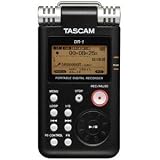
A great choice for journalists, podcasters and on-the-go musicians, the Tascam DR-1 portable recorder features a pair of microphones that are mounted on a variable angle mechanism, which allows the recorder to record from almost any angle. The built-in stereo condenser microphones are arranged for a wide stereo image, and an external mic can also be used. The unit includes a 1 GB SD card for hours of recording at MP3 or WAV file formats.
With the version 2.0 firmware update, the DR-1 offers additional features during recording, including a manual track increment for breaking a long session into individual tracks. The new pre-record buffer feature can store audio in a buffer to begin a recording two seconds before the record button is pressed. Recording can also be delayed by 300ms to eliminate handling noise when the record button is pressed.
Editing features have also been added, including automatic new file creation if the current file becomes too large and an All Delete function that enables you to quickly delete all files within a selected folder.
Key Features
Portable, Handheld Recording
Built-in High-quality Stereo Condenser Microphone
Variable Angle Microphone Mechanism with A/B Configuration
48 or 44.1kHz 24-bit Recording Resolution
MP3 and WAVE file Recording and Playback
Switchable Low Cut Filter
Analog Auto Gain Control
Analog Limiter
Rechargeable/Replaceable Lithium-Ion Battery
USB 2.0 Connection to Computer
Built-in Tuner and Vocal Cancel Features
Overdub Feature to record narration, singing or instruments over an existing recording
1/8-inch stereo microphone input with 2.3V power
1/8-inch stereo line input
1/4-inch stereo microphone input
1/8-inch stereo headphone output
WAV recording resolution: 44.1kHz/48kHz, 16-bit or 24-bit
MP3 recording rate: 32-320 kbps
Battery life: About 7 hours when recording MP3 format with the built- in mic (varies with operating conditions)
Dimensions (not including protrusions): 2.8 x 1.1 x 5.3 inches (WxHxD)
Weight: 7.34 ounces, including battery
Specifications
MIC 2 IN input
Jack: 1/4-inch, mono, unbalanced
Input impedance: 10 kΩ or more
Nominal input level: -50 dBV
Maximum input level: -34 dBV
MIC 1 IN input
Jack: 3.5-mm stereo phone (with plug-in power)
Input impedance: 30 kΩ
Nominal input level: -64 dBV (GAIN set to HIGH); -48 dBV (GAIN set to LOW)
Maximum input level: -48 dBV (GAIN set to HIGH); -32 dBV (GAIN set to LOW)
LINE IN input
Jack: 3.5-mm phone (stereo)
Input impedance: 23 kΩ
Nominal input level: -10 dBV
Maximum input level: +6 dBV
Audio file compatibility
MP3 files: 32–320 kbps; 44.1/48 kHz sampling frequency; VBR (playback only); ID3 tag support up to Ver. 2.4
WAV files: 44.1/48 kHz sampling frequency; 16/24-bit rate
Recording medium: SD card (64 MB–2 GB) or SDHC card (4–32 GB)
File system: FAT16/32
 Get 50% OFF
Click here for more information about Tascam DR-1 Portable Solid State Recorder

0 comments:
Post a Comment